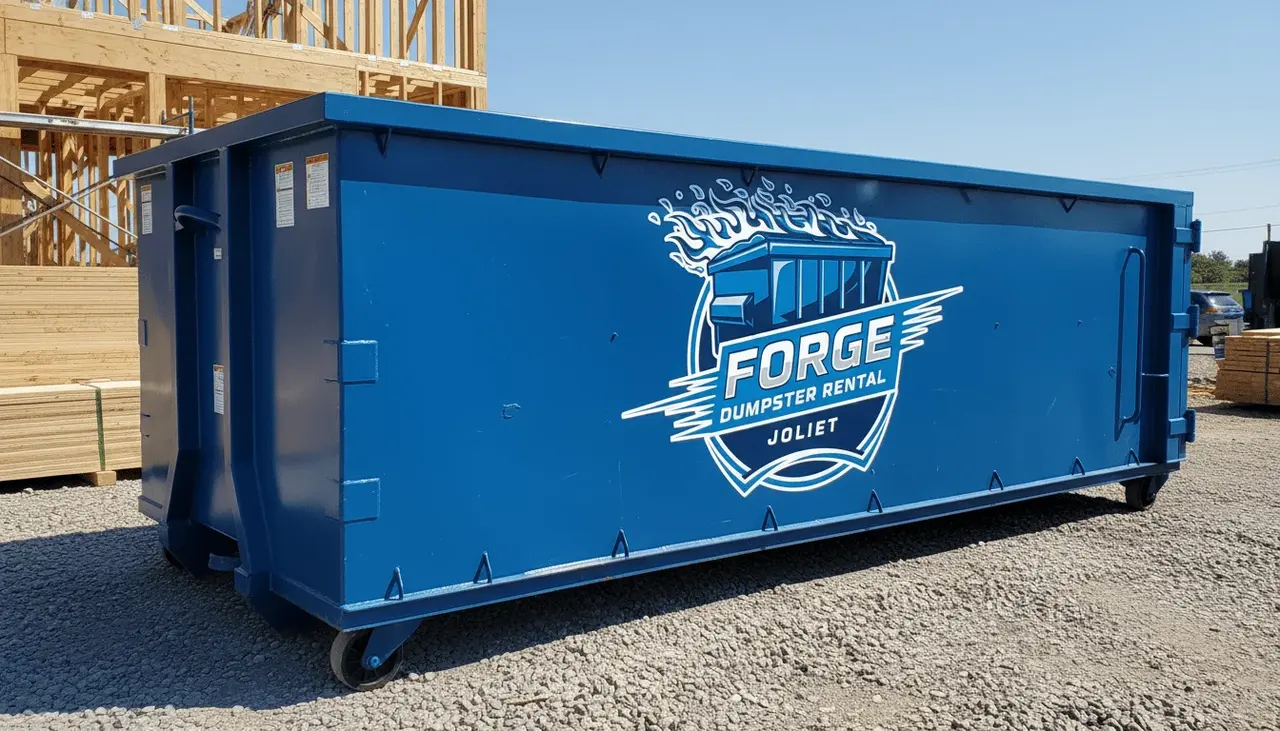
Everyone assumes a full dumpster just disappears. Here's where a Joliet load really ends up, which materials Illinois bans from the landfill outright, and what we pull out before your can ever reaches the scale.
8 min readUpdated 2026-02-17By Forge Dumpster Rental
Once a loaded roll-off pulls out of your driveway, most people never think about it again. Fair enough — that's the point of hiring someone to haul it. But if you're curious, or if you're trying to figure out what's actually allowed in the can you just rented, it helps to know where a Joliet dumpster load really goes, which materials Illinois flatly will not let a landfill accept, and why we ask certain questions before we ever drop a container at your curb.
The Short Version: Where a Will County Load Ends Up
Most general debris hauled out of Joliet and the surrounding Will County towns ends up at one of two kinds of facilities, depending on what's in the load:
Prairie View Recycling and Disposal Facility — the county-owned landfill near Wilmington that handles mixed municipal solid waste and general dumpster debris for the region.
A dedicated construction & demolition (C&D) transfer facility — Joliet has its own C&D transfer operation in the city, which is where clean loads of drywall, lumber, roofing, and demolition debris are more likely to be routed and consolidated before onward disposal or recycling, separate from household trash.
Which one a load goes to depends on the hauler, the account, and what's actually in the container. Concrete and clean aggregate follow yet another path entirely — see our concrete & heavy debris page for how that material gets priced and handled differently from everything else.
Prairie View Recycling and Disposal Facility — the Real Destination
Prairie View Recycling and Disposal Facility sits at 29755 S. Prairie View Dr. in Wilmington, one of the Will County towns we run trucks into every week. It's not a private dump — it's owned by Will County itself and operated through a public-private partnership with Waste Management. The land it sits on was once part of the Joliet Arsenal, the World War II-era Joliet Army Ammunition Plant, and was transferred to the county by the federal government for this purpose. The facility took its first load of municipal solid waste on January 19, 2004, and today processes roughly 2,500 tons of waste a day, with a small recycling drop-off container on site and a gas-to-energy plant that captures the methane the landfill generates and converts it into electricity instead of just flaring it off. Its permitted operating life has been extended out to 2042.
None of that changes how you use a rented dumpster day to day. But it's worth knowing that when a Forge container gets hauled off, it's not going to some unregulated hole in the ground — it's going to a permitted, monitored facility that Will County itself has a direct stake in running responsibly.
Construction Debris Often Has a Different Route
Joliet also has its own construction-and-demolition transfer facility inside the city, run separately from general household trash disposal. A dedicated C&D transfer station exists specifically to weigh, sort, and consolidate building materials — drywall, framing lumber, shingles, siding — before that debris moves on to final disposal or recycling. This is part of why a demolition or heavy renovation project gets handled a little differently on our end than a garage cleanout: the material is genuinely different, and it often travels a genuinely different route. Our demolition debris service and construction dumpster page both walk through how that split works for a specific project.
What Forge Sorts Out Before a Load Reaches the Scale
Illinois doesn't leave this to guesswork. State law bans a specific list of materials from landfill disposal outright, and every hauler in the state — us included — has to work around it. The Illinois Environmental Protection Act has prohibited these categories from landfills for years:
Yard waste (grass, leaves, brush) — banned from landfills since 1990.
Lead-acid batteries (car and marine batteries) — banned since 1990.
Waste tires — whole tires banned from landfill disposal since 1994.
White goods — refrigerators, ranges, water heaters, freezers, and air conditioners, unless certain components are removed first — banned since 1994.
Used oil — liquid used oil can't be mixed into landfill waste at all.
Electronics — computers, monitors, TVs, printers and similar devices have been banned from Illinois landfills since the state's electronics recycling law took effect.
Mercury thermostats — covered by their own dedicated collection law.
Mattresses and textiles aren't on that formal state ban list the way tires and batteries are, but we pull them out of loads just as consistently — they eat volume fast, they don't compact, and there are real recycling routes for the springs and fabric that a straight landfill load skips entirely. That's the same reasoning behind the line in our own service promise: mattresses, textiles, scrap tires and lead-acid batteries all have their own routes under Illinois' waste ban rules, and we'd rather tell you what has to come out before your load reaches the scale than surprise you with a rejected load or an overage charge afterward.
What You Should Separate Yourself
You don't need to sort a dumpster like a recycling plant. But a few minutes of separating before you start filling saves real money and avoids a load getting flagged at the facility:
Tires — set them aside; they need a dedicated tire-disposal route, not a roll-off.
Car and marine batteries — most auto parts stores will take these back, often for a small deposit refund.
Major appliances — fridges, freezers, and window AC units need refrigerant recovered before disposal; tell us up front if one is part of your load so we can point you to the right handling.
Electronics — TVs, computers, and monitors need to go through Illinois' electronics recycling program, not a general dumpster.
Mattresses and box springs — keep these off to the side; ask us about mattress handling when you book if you have more than one.
Paint, chemicals, and fuel — these are household hazardous waste, covered below, and never belong in a roll-off at all.
Material
Goes in a rented dumpster?
Where it actually goes
General household junk, furniture, cleanout debris
Yes
Prairie View Recycling and Disposal Facility
Drywall, lumber, framing, roofing tear-off
Yes
C&D transfer facility or landfill, depending on the load
Concrete, brick, asphalt
Yes, in a dedicated heavy-debris container
Aggregate recycling or landfill, priced by weight
Yard waste, brush, limbs
Only with a dedicated yard-waste order
Composting/yard-waste processing — banned from the landfill itself
Tires
No
Dedicated tire-disposal route only
Lead-acid batteries
No
Battery recycling — often a core refund at auto parts retailers
Major appliances (white goods)
Only after refrigerant recovery
Appliance recycling, components removed first
Electronics (TVs, computers, monitors)
No
Illinois electronics recycling program
Mattresses and box springs
Case by case — ask when booking
Mattress recycling where available
Paint, solvents, pesticides, fuel, pool chemicals
No
Will County household hazardous waste collection only
Household Hazardous Waste Is Never a Dumpster Item
This is worth its own section because it's the one category that genuinely cannot go in a roll-off under any circumstance, not because we're being cautious, but because these facilities aren't permitted to take it. Will County's Land Use, Resource Recovery & Energy Department runs at least two household hazardous waste collection events every spring and one every fall for residents across the county, and it also funds a permanent regional drop-off at the Naperville Regional HHW facility, open weekends year-round. That site takes automotive fluids, oil-based paint and thinners, pesticides and fertilizers, fluorescent and LED bulbs, small propane tanks, fire extinguishers, and pool chemicals — though it does not take latex paint, smoke detectors, ammunition, or business or medical waste, so it's worth checking current accepted items before you make the drive.
If a cleanout you're planning includes a garage shelf of old paint cans, weed killer, or automotive chemicals, plan on setting those aside for one of these collection events rather than tossing them in with everything else. It's a genuinely different disposal system, and mixing hazardous material into a general debris load is the one thing that can actually get a load rejected outright rather than just charged an overage fee.
Why This Matters for Sizing and Cost
Understanding where debris goes isn't just trivia — it's directly connected to what your rental costs. Disposal facilities bill by weight, not by how full a container looks, which is why a 10-yard dumpster of wet shingles or concrete can hit its tonnage limit long before it's visually full, while a 20-yard load of household junk might never come close. That's the whole logic behind our own approach: the right box, not the biggest one. Weight fills a container long before volume does, and we'd rather size you correctly the first time than sell you more container than the job needs. If you're not sure what size fits your specific project, our dumpster sizing guide breaks it down project by project, and the full dumpster sizes page lists dimensions and typical use cases side by side. For a closer look at what actually drives the number on your invoice, see our Joliet dumpster rental cost guide.
The Bottom Line
When Forge hauls a loaded container out of Joliet, Wilmington, or anywhere else across Will County, it's headed somewhere specific and regulated — usually Prairie View Recycling and Disposal Facility, or a dedicated construction-debris transfer point if the load is building material. Illinois law keeps a defined list of items out of that stream entirely, and we sort for those before your load ever reaches the scale rather than after. You don't have to memorize any of this to rent a dumpster from us — that's our job. But if you've got tires, an old car battery, a dead fridge, or a garage of half-used paint cans as part of your project, tell us when you call and we'll tell you exactly where each one actually needs to go.
Have a load with an unusual mix of materials, or a question about something specific before you book? Contact Forge Dumpster Rental and we'll walk through it with you on the phone.
Forge Dumpster Rental
Written by the team that runs the trucks out of our yard on 1602 E Cass St in Joliet. We haul
roll-offs across Will County, Grundy County and the wider Joliet area every week. Questions about your own job?
Call (815) 860-4753.
Talk to a real person
Ready to book a container in Joliet?
Call and describe the job. Flat price, stated tonnage, and a delivery time on the same call.
Where does my Joliet dumpster load actually end up?
Most general debris goes to Prairie View Recycling and Disposal Facility, the Will County-owned landfill near Wilmington operated with Waste Management. Construction and demolition debris is often routed through a dedicated C&D transfer facility in Joliet instead, separate from general household waste.
Can I put tires, car batteries, or appliances in a rented dumpster?
No. Illinois law bans waste tires, lead-acid batteries, and white goods (refrigerators, freezers, water heaters, AC units) from landfill disposal. Tires and batteries need a separate disposal route, and appliances need refrigerant professionally recovered before they can be handled at all.
What should I do with old paint, chemicals, or pesticides during a cleanout?
Hold onto them for one of Will County's household hazardous waste collection events, held at least twice each spring and once each fall, or take them to the permanent Naperville Regional HHW drop-off site, open weekends. These items can never go in a rented dumpster.
Are mattresses and electronics allowed in a Forge dumpster?
Electronics like TVs, computers, and monitors are banned from Illinois landfills and need to go through the state's electronics recycling program. Mattresses aren't formally banned, but we typically pull them separately because of the volume they take up and the recycling routes available for them — ask us when you book.
Does it cost more if my load is heavy, like concrete or wet shingles?
Yes. Disposal facilities charge by weight, not by how full the container looks, so dense material like concrete, brick, or wet roofing shingles can hit a dumpster's tonnage limit well before the box appears full. That's why we size containers around actual project weight, not just visual volume.
Parking a dumpster in your driveway almost never needs a permit in Joliet. Parking one at the curb or in the street is a different matter. Here's how driveway vs. public right-of-way placement works, what the City of Joliet expects, and how to figure out which situation applies to your project.
Between JJC students, young renters, and the steady churn of apartment leases across Joliet, move-out season happens year-round, not just in May. Here's how to time and size a dumpster for a clean, one-pass cleanout.
CenterPoint Intermodal Center has made Will County one of the busiest logistics and construction markets in the Midwest. Here's the real story behind the warehouse boom and what it means for roll-off dumpster planning, on job sites large and small.