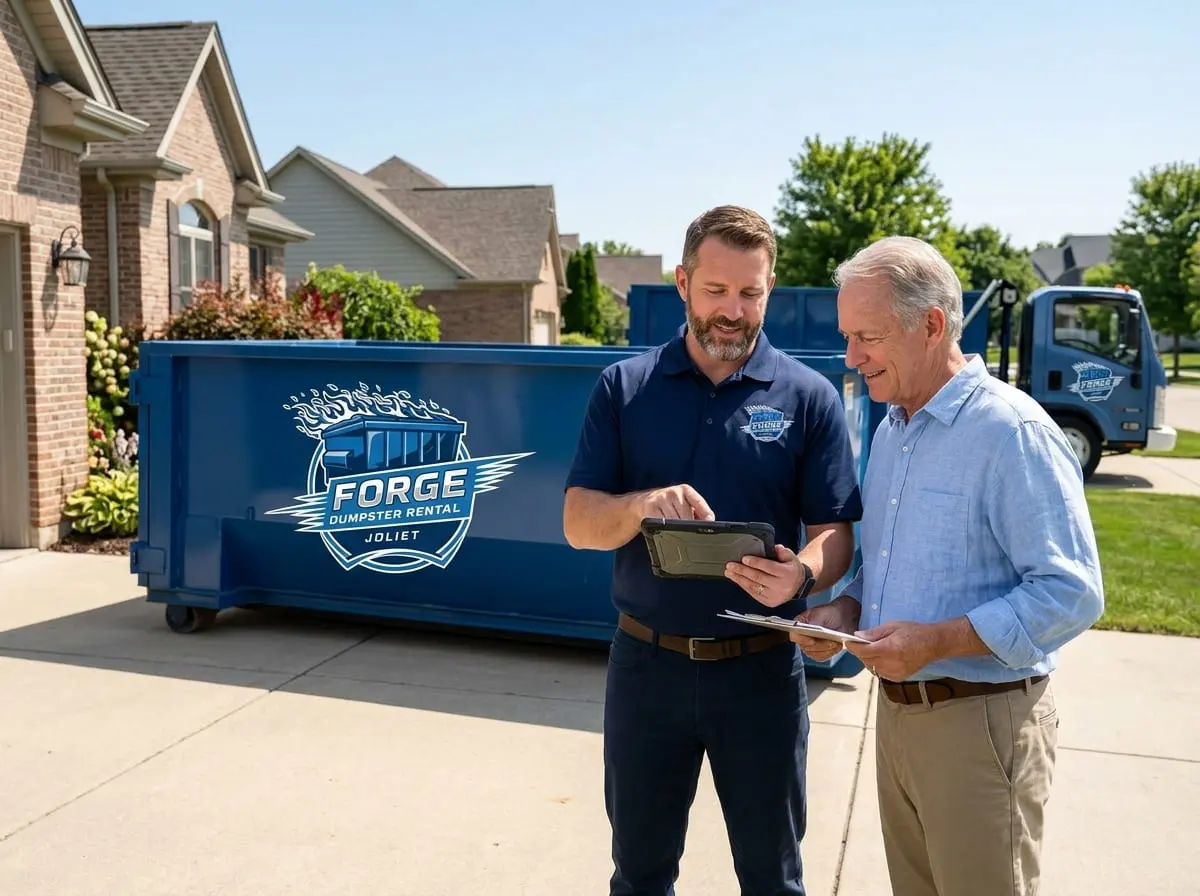
Forge quotes one flat number that bundles delivery, the rental period, pickup, fuel, disposal and a stated tonnage allowance. Here's what's actually in that number, what pushes a job past it, and how to get a quote that holds.
8 min readUpdated 2026-02-07By Forge Dumpster Rental
Ask five dumpster companies what a roll-off costs and you'll get five different answers, and not because
anyone is trying to confuse you. A roll-off rental bundles several real costs into one number — a truck trip out
to your address, a container sitting on your property for a stretch of days, a truck trip back, and a tipping
fee at the disposal facility on the other end. Change any one of those and the number changes. Rather than throw
out a dollar figure that would either be wrong for your job or stale by the time you read this, this guide walks
through how Forge actually structures a quote in Joliet and Will County — what's bundled into the flat price,
what pushes a job past the included tonnage, what isn't covered at all, and what to have ready when you call so
the number you get is the number you pay.
What's Actually Bundled Into a Flat Price
Forge quotes roll-off rentals as one flat number, written down before the truck leaves the yard on Cass
Street. That number is built out of a handful of real cost components, not padded with a mystery fee later:
Delivery — the truck trip from the yard to your driveway, street or jobsite, container set
where you want it, boards laid under the rails on a driveway to protect the concrete or asphalt.
The rental period — an agreed stretch of days the container is yours to fill, on your
schedule, not rushed.
Pickup — the return trip to haul the full container away when you're done or the period is
up.
Fuel — built into the number up front rather than tacked on as a separate line at pickup.
Disposal — the tipping fee paid at the transfer station or landfill to actually get rid of
what's in the box.
A stated tonnage allowance — a specific weight limit that comes with the size you book, told
to you on the phone, not buried in fine print.
That last piece is the one first-time renters underestimate, and it's worth its own section, because weight —
not the container looking full — is what actually determines whether a job stays inside the flat price.
What Pushes a Job Over the Included Tonnage
Every size Forge runs comes with its own stated tonnage allowance, and it's sized around what a typical job of
that kind actually weighs — not around the container's physical volume. Those two things are only loosely
related. A container packed to the rails with old furniture, cardboard and general household junk can be light
by weight even when it looks completely full. The same container filled with concrete, brick, dirt, tile or a
few layers of roofing shingles can hit its tonnage allowance while still looking half-empty, because dense
material weighs many times more per cubic foot than bulky, light material does.
That mismatch is exactly why a mixed-debris job and a heavy-debris job aren't priced the same way, and why
Forge asks what's actually going into the container before quoting a number. A whole-house cleanout full of
furniture, boxes and general junk behaves very differently on the scale than a driveway tear-out or a full roof
strip. If your project mixes the two — say, a remodel with drywall and cabinetry alongside a torn-out concrete
patio — it's worth mentioning both, because the honest answer is sometimes two containers or a dedicated
low-volume box for the heavy stuff rather than one can trying to do both jobs. Going over the stated tonnage
means an overage charge calculated on the extra weight, billed after the container crosses the scale — the kind
of surprise a five-minute phone conversation up front avoids entirely.
What's Not Included, and What Costs Extra
A flat price covers a defined job — a given size, a given rental period, a given tonnage allowance, and
ordinary debris. A few things sit outside that and either can't go in the container at all or get handled
separately:
Overage weight. Material beyond the stated tonnage allowance is billed as an add-on, not
folded silently into the base price.
Extra rental days. The rental period is part of the flat quote; keeping the container
noticeably longer than agreed — a stalled remodel, a slow cleanout — typically means an added per-day charge, so
it's worth being realistic about your timeline when you book.
Prohibited and regulated items. Illinois' waste ban rules keep certain items out of a
standard roll-off entirely, regardless of price — mattresses, textiles, scrap tires and lead-acid batteries all
have their own separate disposal routes rather than going in with general debris. Hazardous materials — paint,
solvents, chemicals, fuel — and appliances still holding refrigerant are generally off-limits too. Forge tells
you what has to come out of a load before it reaches the scale, not after, so it doesn't turn into a rejected
load or a surprise sorting fee on delivery day.
Street or right-of-way permits. If there's no room for the container on your own property
and it has to sit on a public street, a City of Joliet permit may be required — a real added step and sometimes
a fee, not something Forge controls. Our Joliet
dumpster permit and street placement guide covers when this applies and how to sort it out before delivery
day instead of after the truck shows up.
How Size Moves the Price
Size is the first lever most people think of, and it does move the number — but not in a straight line, and
not by itself. Because delivery and pickup cost roughly the same trip regardless of container size, a jump from
a 10-yard to a 15-yard often costs less proportionally than you'd expect, while the tonnage allowance and the
disposal volume behind it are what really separate the sizes:
Large commercial fit-outs, industrial clear-outs, high-volume light debris
The honest sizing advice cuts both ways. Renting bigger than you need wastes money on a tonnage allowance and
rental period you never use. Renting smaller than you need on a heavy job risks blowing through the tonnage
allowance early and paying an overage on top of what a properly-sized container would have cost outright. Forge
would rather talk you into the box that actually fits the job — sometimes smaller than what you called in
asking for — than sell you the biggest can on the lot. If you're not sure where your project lands, our
dumpster sizes guide breaks down dimensions and typical loads for all five
sizes.
Other Things That Move a Joliet or Will County Quote
A few factors specific to where the container is going also feed into the number:
Distance from the yard. Forge runs out of a Cass Street yard in Joliet. A delivery inside
the city is a shorter round trip for the truck than one out toward the edges of Will County or into
Grundy County, and trip distance is a real, physical cost input rather than an arbitrary add-on.
Site access. A flat, paved driveway with clear overhead clearance is the easiest drop for a
loaded roll-off truck. A steep or gravel drive, a tight lot, low tree limbs or overhead lines can all affect how
a delivery is handled — worth mentioning when you book so the driver shows up prepared instead of improvising on
the spot.
Same-day timing. Forge runs most Joliet orders called in before noon the same day, including
priority swap-outs on live jobsites. Same-day service itself doesn't carry a separate markup, but a rushed,
same-day booking leaves less room to talk through sizing in detail than a call placed a day or two ahead.
How to Get a Quote That Actually Holds
The fastest way to a real number is a short phone call with a few honest answers ready, not a guess pulled
from a website table. When you call, it helps to know:
What kind of project this is — cleanout, remodel, roofing, new construction, demolition, yard work.
What's actually going in the container — general mixed debris, yard waste, or heavy material like concrete,
brick or shingles.
Roughly how much material you're dealing with — a garage's worth, a full house, a roof tear-off.
How long you realistically expect to need the container on-site.
Where it will sit — driveway, yard or street — and whether access is straightforward.
With those five answers, Forge can give you one flat number covering delivery, the rental period, pickup,
fuel, disposal and a stated tonnage allowance — and flag anything, before the truck leaves the yard, that would
push the job past it. That's the whole approach: price it honestly on the front end so there's nothing to
untangle on the back end.
Get an Accurate Quote for Your Joliet Job
Pricing structure is useful for planning, but nothing replaces a short conversation with someone who knows the
weights and the streets. Call Forge Dumpster Rental and describe the job — you'll get a flat price on the same
call, not a follow-up email days later. Browse the full dumpster sizes lineup,
see all rental services, or reach out through the
contact page to get pricing that actually matches your project.
Forge Dumpster Rental
Written by the team that runs the trucks out of our yard on 1602 E Cass St in Joliet. We haul
roll-offs across Will County, Grundy County and the wider Joliet area every week. Questions about your own job?
Call (815) 860-4753.
Talk to a real person
Ready to book a container in Joliet?
Call and describe the job. Flat price, stated tonnage, and a delivery time on the same call.
Why won't Forge just give me a flat number without asking questions first?
Because a price quoted blind would either overcharge a small, light job or undercharge a heavy one. Size, tonnage, debris type, rental length and site access all factor into an accurate flat price, so a few quick questions about your specific job get you a number that actually holds instead of a generic range that might not apply to what you're hauling.
What happens if my job goes over the included tonnage allowance?
You're billed an overage charge on the extra weight once the container crosses the scale at the disposal facility. This is most common on jobs with dense material — concrete, brick, dirt or a full layer of roofing shingles — that hit the weight limit before the container looks full. Telling Forge what's actually going in the box before delivery is the easiest way to avoid it, since it may mean a different size or a dedicated heavy-debris container instead.
Does keeping the dumpster longer than planned cost extra?
The rental period is part of the flat quote, so staying inside it costs nothing extra. Running noticeably past it — a stalled remodel, a cleanout that takes an extra weekend — typically adds a per-day charge. If you expect a project to run long, mention it when you book so the rental period is set realistically from the start.
What items can't go in a Forge dumpster, and does that affect price?
Illinois' waste ban rules keep certain items out of a standard roll-off no matter what you'd pay for them — mattresses, textiles, scrap tires and lead-acid batteries all have separate disposal routes. Hazardous materials like paint, chemicals and fuel, along with appliances still holding refrigerant, are generally off-limits too. Forge flags these before the container reaches the scale so a load doesn't get rejected or hit with a sorting fee on delivery day.
Will I need a permit for a dumpster in Joliet, and does that cost extra?
If the container fits on your own driveway, yard or lot, a permit generally isn't required. If there's no room on-site and it has to sit on a public street, a City of Joliet permit may be needed, which can add a step and sometimes a fee outside Forge's control. See our dumpster permit and street placement guide for details on when this comes up.
What should I have ready when I call for a Joliet or Will County quote?
Have a sense of the project type, what's actually going in the container (general debris, yard waste, or heavy material like concrete or shingles), roughly how much material you're dealing with, how long you'll realistically need the container, and where it will sit on your property. That's enough for Forge to quote your Joliet or Will County job accurately on the first call.
Illinois doesn't use “811” or “Dig Safe” as its call-before-you-dig brand — it's JULIE. Here's exactly when Illinois law requires you to call before digging, and how that connects to where a Forge roll-off actually gets set down in Joliet.
Everyone assumes a full dumpster just disappears. Here's where a Joliet load really ends up, which materials Illinois bans from the landfill outright, and what we pull out before your can ever reaches the scale.
Parking a dumpster in your driveway almost never needs a permit in Joliet. Parking one at the curb or in the street is a different matter. Here's how driveway vs. public right-of-way placement works, what the City of Joliet expects, and how to figure out which situation applies to your project.