
Same-Day Dumpster Rental Joliet, IL | Forge
A straight answer on same-day dumpster delivery in Joliet: the call-before-noon cutoff, live jobsite swap-outs, what to have ready when you call, and when same-day genuinely isn't realistic.
ReadJoliet, IL guide
Roofing debris is heavy, not just bulky — so the right dumpster for a Joliet tear-off comes down to weight first, volume second. Here's how squares, layers, and shingle type set the size.
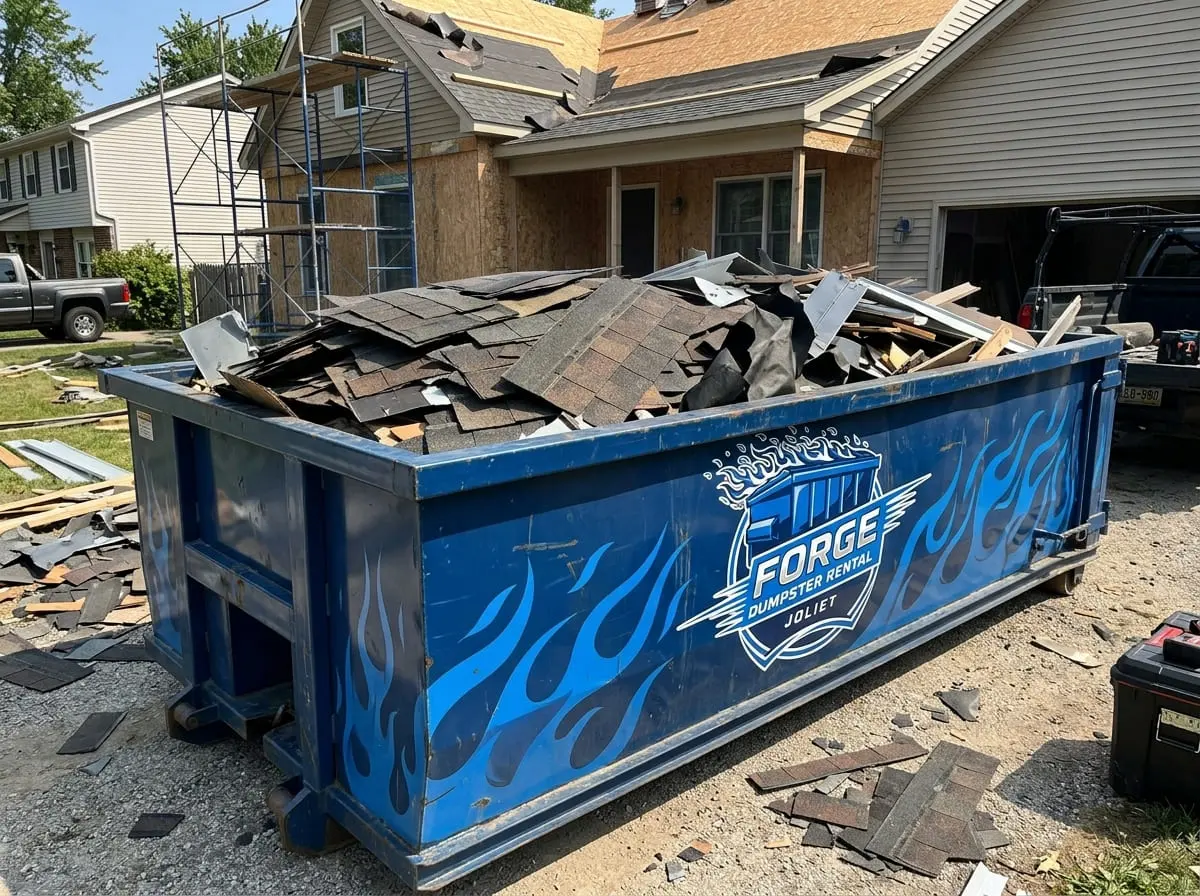
Most dumpster sizing comes down to volume — how much space the debris takes up. Roofing tear-offs are the exception. A pile of old asphalt shingles in the yard doesn't look like much, but shingles are one of the densest materials a roll-off ever hauls. A 20-yard container that would easily swallow a garage cleanout can hit its weight limit from shingles alone while the box still looks half-empty. Order by volume alone on a reroof and you'll either pay an overweight fee or need a second pickup mid-job.
That trade-off shows up constantly around Joliet and Will County. A lot of the housing stock here dates to the subdivision growth of the 1990s and early 2000s, which puts a large share of local roofs squarely inside the 20–25 year window where asphalt shingles fail. Add Illinois' hail and wind events, which push storm-damaged roofs into an insurance-driven reroof outside the normal cycle, and roofing tear-offs are a steady reason contractors and homeowners call us. Getting the size right on the first call means one container, one haul, and a crew that isn't waiting on a swap.
Roofers measure roof area in “squares.” One square equals 100 square feet of roof surface — a 10-foot by 10-foot section. A typical single-story home in the Joliet area runs somewhere around 15–20 squares; a larger two-story home can run 25–35 squares or more, and pitch matters — a steep roof has meaningfully more surface area than its footprint suggests. Your roofing contractor already has this number on the estimate; homeowners gathering quotes should ask for the square count by name, since it's more useful for sizing a container than the house's square footage.
Weight per square varies more than most people expect, and it's the number that actually decides your dumpster:
Do the math on a mid-size home: a 20-square roof with architectural shingles runs roughly 8,000–9,000 lbs of tear-off debris before underlayment, flashing, or damaged decking goes in — close to 4.5 tons from shingles alone.
These are planning ranges for a single layer of standard architectural shingle tear-off, no other demo debris mixed in. Treat this as a starting point — every roof's waste factor and pitch differs, and we'll confirm the exact size on your call.
| Dumpster Size | Weight Limit | Typical Roof (Single Layer) | Best For |
|---|---|---|---|
| 10-yard | 1–2 tons | Up to ~8–10 squares architectural, or up to ~15 squares of lighter 3-tab | Sheds, porch roofs, additions, small garages |
| 15-yard | 2–3 tons | ~10–14 squares | Most single-story Joliet-area homes |
| 20-yard | 3–4 tons | ~14–18 squares | Larger single-story or modest two-story homes |
| 30-yard | 4–5 tons | ~18–24 squares, or most double-layer tear-offs | Large two-story homes, steep or cut-up rooflines, layered tear-offs |
Notice the sizes don't scale in a straight line the way they would for a light, bulky material. Each step up buys roughly 4–6 more squares of headroom, not double. That's why a 30-yard, not a 40-yard, is usually the ceiling for roofing — see the note on the 40-yard below.
The biggest variable after roof size is how many layers of shingles are coming off. Building code generally allows a maximum of two layers of asphalt shingles before a full tear-off is required, and plenty of homes that have changed hands once or twice carry that second layer — installed over the first instead of a full strip. It's legal within limits, but it roughly doubles the debris weight when it finally comes off.
Your roofer will confirm the layer count as soon as tear-off starts, if not sooner from an attic look or a pried-up shingle edge. Homeowners without that answer yet should get it before locking in a size.
For the most common job we see — a single-story, single-layer, architectural-shingle roof — the call usually comes down to the 15-yard versus the 20-yard. Under roughly 1,200–1,400 sq ft of footprint (12–14 squares after pitch and waste), the 15-yard is typically the right fit; a larger footprint, a steep pitch, or dormers and valleys that generate extra cut waste push it to the 20-yard. Not sure which side you're on? Size up — an underfilled dumpster costs nothing extra, but hitting the weight ceiling mid-tear-off stalls the crew and adds a swap. Full dimensions for every size are on our dumpster sizes page, and our roofing dumpster rental page covers what a typical Joliet tear-off rental includes.
A few situations reliably call for our largest roofing container, or occasionally a second one on the same job: two-story homes with 22+ squares, any double-layer tear-off beyond a modest single-story roof, steep or heavily cut-up rooflines with lots of valleys and dormers, or a tear-off combined with other demolition like rotted decking or old skylights. On bigger production jobs, some crews prefer two smaller containers swapped mid-project over one oversized box sitting in the driveway all day — it keeps the truck from blocking access and lets the crew keep working while one load gets hauled. Ask about a swap-out schedule when you book if that fits better.
A note on the 40-yard: we offer it, but rarely put shingles in one. At 8 feet tall, it's built for bulky, lighter material — loading it much past a third full with dense debris pushes weight high in a tall box, harder to load safely without buying real extra capacity once the ton limit is reached. For roofing, a 30-yard (or a second container) almost always beats a 40-yard.
Everything above assumes standard asphalt shingle, by far the most common material we see locally. Metal roofing is lighter by weight but bulky and sharp-edged — break panels down and lay them flat rather than tossing them in bent, or they waste volume fast. Concrete or clay tile makes weight the entire story: even a modest tile roof can approach a container's practical limit, so call ahead before sizing that kind of tear-off. Wood shake is bulkier per square with a lot of splintered offcuts — it sizes similarly by weight but fills the box faster by volume.
Where the dumpster lands matters almost as much as its size. Roofing debris comes off fast once the crew starts stripping, and every extra foot between the eave and the container is distance spent dragging shingles. Position it as close to the roofline as the driveway allows — ideally directly below or just past the eave on the side the crew works first, so debris drops almost straight down instead of getting carried. Check overhead clearance before delivery, since power lines and low tree limbs are what most often force a container further out than a crew would like, and confirm the truck's approach: a straight driveway shot is easiest, while tight side-yard placements need a call ahead so we can plan the drop. Leave the crew room to work around the box, too — one jammed against a garage door can end up blocking the exact access it was placed to serve.
Roofing dumpsters take a beating — falling shingles, dropped nails, and pry bars are hard on whatever surface sits underneath them, and a fully loaded 20 or 30-yard is heavy. Ask about placement boards if your driveway is older or already cracked; boards spread the container's point load across the wheels and axle rails rather than concentrating it. Stage a tarp or sheet of plywood under the drop zone before tear-off starts — it catches stray nails and grit and turns a slow sweep into a fold-and-toss cleanup. Once the tear-off is done, run a magnetic sweep of the driveway and grass, since nails travel farther than people expect off a pitched roof, and keep kids and pets clear until the site's swept. If the container has to sit in the street rather than your own driveway, check our guide on dumpster permits and street placement in Joliet for when the city gets involved.
The honest answer to “what size dumpster do I need for my reroof” is almost always: tell us the square count, shingle type, and layer count, and we'll size it right the first time. Weight decides the roofing conversation, not how big the pile looks — getting it right up front means one container, one pickup, and a crew that isn't waiting on a swap.
Call Forge Dumpster Rental at (815) 860-4753 and describe your roof, and we'll recommend the right container and get a delivery time on the same call. We're open Monday through Saturday, 7:00 AM to 7:00 PM, and we deliver throughout Joliet and Will County. See every option on our dumpster sizes page or reach out through our contact page to lock in a delivery window.
Talk to a real person
Call and describe the job. Flat price, stated tonnage, and a delivery time on the same call.
Mon–Sat 7:00am – 7:00pm
From this guide
A 20-square roof with standard architectural shingles and a single layer coming off typically calls for a 20-yard dumpster, since that's roughly 8,000–9,000 lbs of shingle weight alone and lands near the top of the 20-yard's 3–4 ton capacity. If a second layer is coming off, or the roof has a steep pitch or a lot of dormers and valleys, size up to the 30-yard instead. Call us with your square count and layer count and we'll confirm before you book.
It depends on the shingle type. Standard 3-tab asphalt runs roughly 230–250 lbs per square (100 sq ft), while architectural or dimensional shingles — the standard on most newer and re-roofed homes in the Joliet area — run closer to 400–450 lbs per square. Concrete or clay tile is far heavier, often 900+ lbs per square. That weight, not the size of the pile, is usually what sets your dumpster size on a roofing job.
Yes. Removing two layers of shingles roughly doubles the debris weight for the same roof footprint, so a 14-square, two-layer tear-off produces about as much weight as a 24–26 square single-layer job. Most double-layer tear-offs need a 30-yard container, and larger double-layer roofs may need a mid-project swap or a second dumpster rather than one overloaded box.
Light related debris like old flashing, gutters, or damaged roof decking is fine mixed in with shingles. Avoid combining shingles with other heavy materials such as concrete, brick, or dirt — stacking a second dense material on top of already-heavy roofing debris is the fastest way to hit a weight limit before the container looks full. Keep the roofing dumpster dedicated to roofing and light related tear-off waste.
As close to the eave as your driveway and overhead clearance allow, ideally on the side the crew strips first so debris drops close to straight down instead of getting carried across the yard. Check for power lines and low tree limbs before delivery, and stage a tarp or plywood under the drop zone to catch stray nails and protect the driveway surface. If the container needs to sit in the street rather than your driveway, check Joliet's placement rules first.
Keep reading
A straight answer on same-day dumpster delivery in Joliet: the call-before-noon cutoff, live jobsite swap-outs, what to have ready when you call, and when same-day genuinely isn't realistic.
ReadTwo services get lumped together constantly. Here's how to tell which one actually fits your project — and where Forge's own junk removal dumpster splits the difference.
ReadFrom a two-car garage purge to framing debris off a CenterPoint jobsite, here are eight real Joliet-area project types and the dumpster size that typically fits each one.
Read